
Where Dogs Are Gods: Experiencing the Sacred Animal Rituals of Tihar in Nepal
Sacred Paws & Wings: Why Animals Are Worshipped During Nepal’s Tihar Festival
As the post-monsoon skies clear into crisp autumn blue and the snow-clad peaks of the Himalayas glitter in the distance, Nepal transforms into a living canvas of marigold garlands, glowing oil lamps, and vibrant rangoli. This is Tihar (also known as Deepawali or Yamapanchak)—Nepal’s five-day Festival of Lights.
While millions around the world celebrate the triumph of light over darkness, Nepal’s Tihar stands apart for one extraordinary reason: before worshipping gods, Nepal worships the animals that share our world.
For the first four days of Tihar, crows, dogs, cows, and oxen take center stage. Honored with crimson tika (vermilion paste), fragrant Sayapatri (marigold) garlands, and royal feasts, these creatures are celebrated for their spiritual connection to Yama (the Hindu God of Death) and their timeless companionship with humanity.
For travelers trekking in the mountains or exploring the ancient courtyards of Kathmandu, witnessing Tihar offers an unforgettable glimpse into the compassionate heart of Nepali culture.
Day 1: Kaag Tihar — Appeasing the Winged Messengers
Tihar begins by looking to the skies with Kaag Tihar (Day of the Crow). In Hindu mythology, crows and ravens are regarded as the informants and messengers of Yamaraj, the Lord of Death. Their distinct cawing is traditionally seen as a symbol of impending news or a reminder of human mortality.
At dawn on the first day, before any family member takes a bite of food, households place leaf-plates filled with rice, grains, sweets, and seeds on rooftops, balconies, and courtyards. By feeding and honoring the crows, families express gratitude to nature’s messengers and pray to keep sorrow, bad news, and misfortune away from their homes for the year ahead.
Day 2: Kukur Tihar — The Day Every Dog in Nepal Is Sacred
Perhaps the most famous and heartwarming day of the festival is Kukur Tihar (Day of the Dogs). On this day, Nepal becomes heaven on earth for canines.
In the ancient Rigveda and Mahabharata, dogs are revered as the guardians of the gates of the afterlife and the faithful companions of Lord Bhairava (a fierce manifestation of Lord Shiva). Yet beyond mythology, Kukur Tihar is a deeply emotional celebration of the unconditional loyalty, protection, and friendship dogs offer humans—from city streets to high Himalayan shepherd trails.
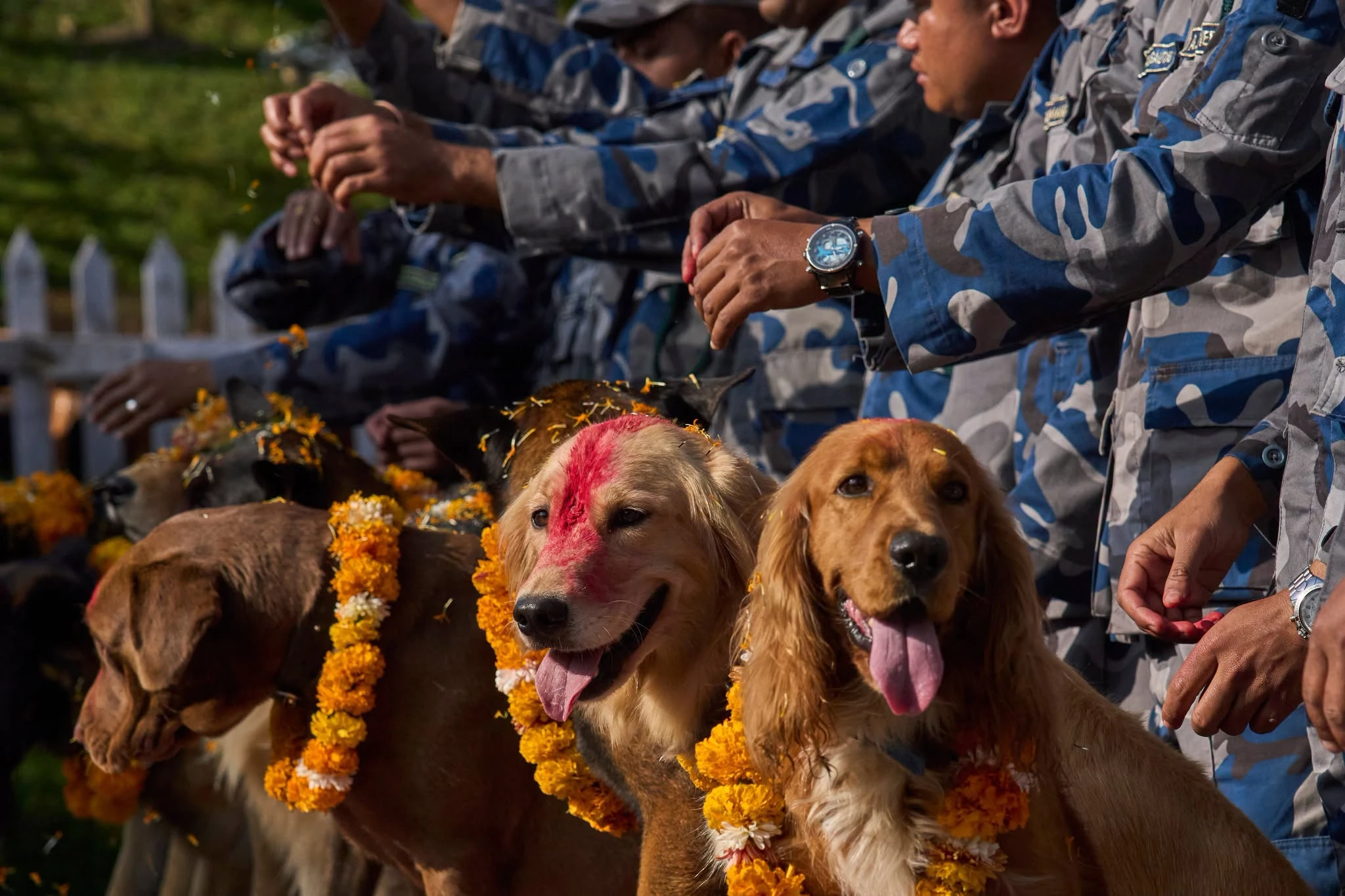
What makes Kukur Tihar truly magical for visitors:
No Dog Is Left Behind: Both pampered household pets and scruffy neighborhood street dogs receive the exact same royal treatment.
The Ritual of Respect: Every dog is adorned with a bright orange marigold garland (mala) around its neck and a red tika (made of yogurt, rice, and vermilion) on its forehead.
Heroic Honors: Even the canine divisions of the Nepal Police and Armed Police Force hold special parades, awarding medals, garlands, and feasts to service dogs trained in mountain rescue and security.
A Grand Feast: Walk down any lane in Kathmandu, Pokhara, or a mountain village, and you will see dogs happily feasting on boiled meat, eggs, milk, curd, and gourmet treats offered by passersby.
Day 3: Gai Tihar — Revering the Sacred Mother & Welcoming Wealth
The morning of the third day is dedicated to Gai Tihar (Worship of the Cow). In Nepal’s historically agrarian society, the cow is revered as the ultimate symbol of motherhood, selflessness, and sustenance. Historically, cow’s milk nourished families, clarified butter (ghee) lit temple lamps, and natural dung fertilized terraced Himalayan fields.
Spiritually, the cow is considered the earthly embodiment of Goddess Laxmi, the deity of wealth and prosperity.
During the morning rituals, cows are bathed, painted with auspicious saffron and flour prints, crowned with flower garlands, and fed fresh grass, fruits, and Sel Roti (traditional ring-shaped sweet rice bread). Devotees tie a sacred yellow and red thread around the cow's tail and duck underneath her—a ritual believed to help souls cross the mythical Vaitarani River into the afterlife. As night falls, the celebration transitions into Laxmi Puja, when every window, doorway, and temple in Nepal is illuminated by thousands of flickering clay oil lamps (diyo).
Day 4: Goru Tihar — Honoring the Strength of the Ox
While the cow symbolizes nourishment, the fourth day—Goru Tihar (Day of the Ox)—pays tribute to strength, endurance, and agricultural partnership.
Across Nepal’s steep terraced hills where modern tractors cannot reach, the ox (Goru) remains the backbone of rural farming, plowing the soil that feeds the nation. On Goru Tihar, oxen are given a well-deserved day of rest, decorated with vibrant tika and garlands, and fed nutritious grains and salt. Many Vaishnav devotees also observe Govardhan Puja on this day, crafting miniature mountain replicas out of cow dung to honor Lord Krishna and the natural environment that sustains life.
(Note: Day 4 is also celebrated as Mha Puja by the indigenous Newar community of the Kathmandu Valley—a profound ritual dedicated to worshipping one's own soul and inner divinity—followed by Bhai Tika on Day 5, celebrating the eternal bond between brothers and sisters.)
Quick Overview: The 5 Days of Tihar at a Glance
Day of Tihar | Nepali Name | Who Is Worshipped | Cultural & Spiritual Meaning |
Day 1 | Kaag Tihar | Crows & Ravens | Messengers of Yama; worshipped to ward off grief and bad news. |
Day 2 | Kukur Tihar | Dogs (Pets & Strays) | Guardians of the afterlife & loyal companions; honored for devotion. |
Day 3 | Gai Tihar & Laxmi Puja | Cows & Goddess Laxmi | Symbol of motherhood, nourishment, and welcoming prosperity. |
Day 4 | Goru Tihar & Mha Puja | Oxen & The Inner Self | Gratitude for agricultural labor; Newari purification of the soul. |
Day 5 | Bhai Tika | Brothers & Sisters | Siblings exchange seven-colored tika and garlands for long life. |
Why Tihar Is the Best Time to Visit Nepal
Falling between late October and mid-November (depending on the lunar calendar), Tihar coincides with Nepal’s peak autumn trekking season. Whether you are wandering through the UNESCO World Heritage squares of Kathmandu, relaxing lakeside in Pokhara, or trekking toward Everest Base Camp, Annapurna, or Manaslu, you will feel the festival’s warmth everywhere:
A Living Lesson in Coexistence: In an era disconnected from nature, watching an entire nation pause to bow before street dogs, crows, and cattle is deeply moving.
Deusi-Bhailo Caroling: In the evenings, groups of children and neighbors go door-to-door singing traditional Deusi and Bhailo folk songs, dancing in courtyards illuminated by fairy lights and oil lamps.
Unbeatable Mountain Weather: The air is crystal clear, daytime temperatures are pleasant, and trails are lined with blooming marigolds and purple globe amaranth (Makhamali) flowers.
Experience the Magic of Tihar With Us
Want to witness Kukur Tihar firsthand or combine a cultural festival tour in Kathmandu with a classic Himalayan trek? Our local guides bring you beyond the tourist trail—inviting you into authentic Nepali homes to make Sel Roti, light clay diyos, and celebrate Tihar alongside local families.
Written by: Trekking Top Nepal
Updated: Nov 9, 2026
Conversation
Comments (0)
Join the conversation
Sign in to post a comment, reply to other travelers, and like helpful responses.